
In short: in the City of Calcutta, civil suits up to ₹10 lakh go to the City Civil Court; from ₹10 lakh to ₹1 crore you may choose it or the High Court; above ₹1 crore the High Court decides (Section 5, City Civil Court Act, 1953). Criminal cases go to the Metropolitan Magistrates and the City Sessions Court at Bankshall Street.
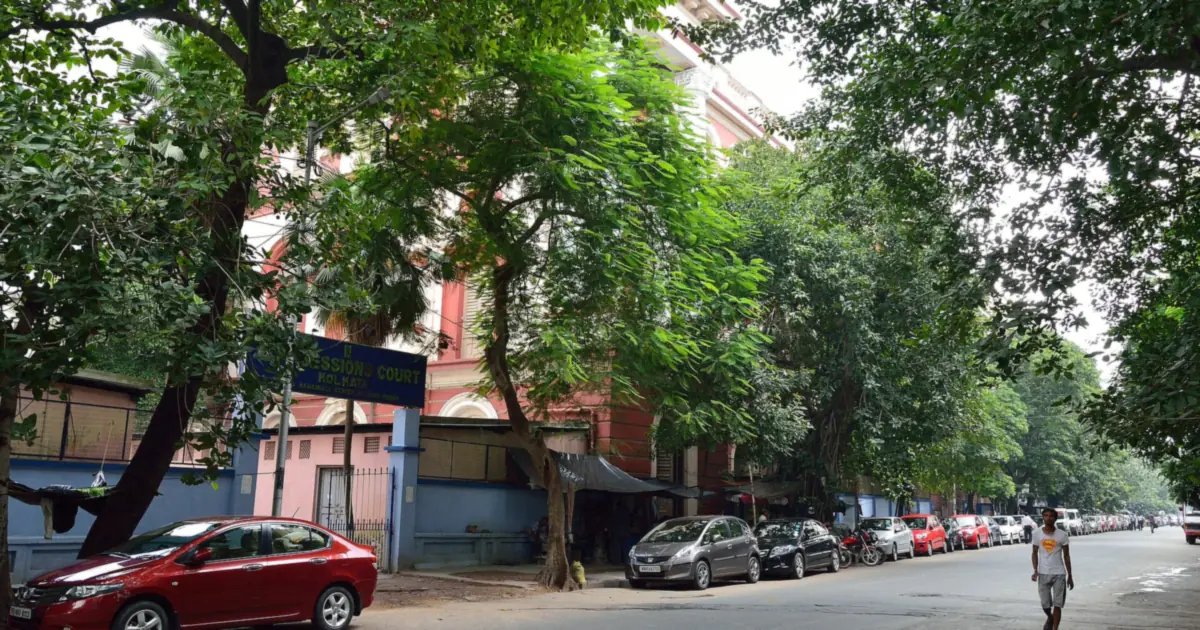
The courts of the city, in one place
Central Kolkata has its own set of courts, separate from the district courts around it. They are a few minutes' walk from each other near BBD Bagh:
- City Civil Court, Calcutta: 2 & 3 Kiran Shankar Roy Road, Kolkata 700001. Civil suits and many civil proceedings for the city.
- Presidency Small Causes Court, Calcutta: the same address. One of the oldest courts in the city, governed by the Presidency Small Cause Courts Act, 1882.
- City Sessions Court and the Chief Metropolitan Magistrate's courts: 2 & 3 Bankshall Street, Kolkata 700001, the buildings known as "Bankshall Court". The Chief Metropolitan Magistrate and the Metropolitan Magistrate courts sit here.
- Family Court, Calcutta: in the City Civil Court complex. It hears divorce, custody and maintenance cases for the city.
Esplanade Metro station (Blue Line) and Mahakaran Metro station (Green Line) are within walking distance of this court area.
City Civil Court Kolkata: pecuniary and territorial jurisdiction
The City Civil Court was set up on 23 February 1957 under the City Civil Court Act, 1953, to take ordinary civil suits off the High Court's Original Side. Its limits are in Section 5 of that Act:
- Territory. The "City of Calcutta" (Section 5(1)). This is the old city, not every area of today's Kolkata Municipal Corporation. Many south and south-west Kolkata areas file at Alipore instead, and Salt Lake and New Town come under North 24 Parganas.
- Up to ₹10 lakh. Only the City Civil Court can try the suit (Section 5(2)).
- Above ₹10 lakh up to ₹1 crore. The City Civil Court and the High Court have concurrent jurisdiction, so the plaintiff chooses. This range comes from the City Civil Court (Amendment) Act, 2013 (West Bengal Act XVIII of 2013), which raised the ceiling from ₹10 lakh to ₹1 crore.
- Above ₹1 crore. The suit goes to the High Court's Original Side.
- Special proceedings. Section 5(3) gives the City Civil Court jurisdiction for the city under the Guardians and Wards Act, 1890 and the Indian Succession Act, 1925 (for example, succession certificates).
- Exclusions. Matters in the Act's First Schedule stay with other courts, for example admiralty, company matters and the High Court's matrimonial jurisdiction.
Which court for which matter in Kolkata
| Matter | Usual court in the city |
|---|---|
| Money recovery, property, injunction suit up to ₹10 lakh | City Civil Court |
| Civil suit over ₹10 lakh up to ₹1 crore | City Civil Court or High Court (Original Side), your choice |
| Civil suit over ₹1 crore | High Court (Original Side) |
| Cheque bounce (Section 138 NI Act) | Metropolitan Magistrate, Bankshall Street, if the payee's bank branch is in the city |
| Arrest, remand and first bail | Metropolitan Magistrate for the police station |
| Serious offences, sessions bail and anticipatory bail | City Sessions Court, Bankshall Street |
| Tenant eviction (West Bengal Premises Tenancy Act, 1997) | City Civil Court or High Court, by the valuation of the suit. Whether the Presidency Small Causes Court can try eviction suits under the 1997 Act has been contested in recent Calcutta High Court rulings, so check the current position before filing |
| Divorce, custody, maintenance | Family Court, Calcutta |
| Consumer complaint | Kolkata District Consumer Disputes Redressal Commission (by police-station area) |
For bail, the new and old sections are Section 483 BNSS (old Section 439 CrPC) for regular bail and Section 482 BNSS (old Section 438 CrPC) for anticipatory bail.
Bankshall Court: City Sessions Court and Metropolitan Magistrates
Criminal cases from most Kolkata Police stations within the city are handled at 2 & 3 Bankshall Street. A person arrested in the city is produced before the Metropolitan Magistrate for that police station, where remand and first bail are decided. Sessions cases, appeals from magistrates and bail in serious offences go to the City Sessions Court, headed by the Chief Judge. Not every Kolkata Police station maps to Bankshall: some go to the Sealdah courts and some to Alipore, so check the police station first.
To find which magistrate deals with a police station, use the "Police Station Wise Magistrate" and "Duty Magistrate" pages on citysessions.dcourts.gov.in.
Sealdah court
The Sealdah court complex, including the Sealdah Railway courts, is part of the South 24 Parganas district judgeship, not the city courts. It has magistrates' courts and Additional District and Sessions Judges' courts, and it hears cases from some Kolkata Police stations, such as Tala. Its case status is searched under South 24 Parganas on the eCourts portal. One of Kolkata's district consumer commissions also sits in the Sealdah court building. When it opened in 2021 it covered 14 police-station areas, including Tala, Maniktala, Beliaghata, Entally, Tangra, Topsia, Kasba and Anandapur.
City Civil Court Kolkata case status and cause list
- Pick the right court website. City Civil Court: citycivilcourtcalcutta.dcourts.gov.in. City Sessions and magistrate courts: citysessions.dcourts.gov.in. Small Causes Court: psccourt.dcourts.gov.in.
- Case status. Search by case number, FIR number, party name, advocate name or Act. The same data is on services.ecourts.gov.in (choose West Bengal and the court).
- CNR number. The 16-character CNR on your court papers finds the case directly on the portal, the eCourts Services app, or by SMS "ECOURTS <CNR>" to 9766899899.
- Cause list. Each website has a daily board showing the cases listed in each court.
- Orders, caveats and holidays. The same websites have order search, caveat search and the yearly holiday list.
E-filing and hearing days
Civil and criminal cases in these courts can be e-filed on efiling.ecourts.gov.in by an advocate or a party-in-person, and court fees paid online through the eCourts e-payment system. On a hearing day, carry:
- a government photo ID;
- the case number, CNR and court number;
- copies of the plaint, written statement, complaint, earlier orders and any summons;
- in a cheque bounce case, the cheque, the bank's return memo, the demand notice and its postal proof;
- in a bail matter, the surety's ID and documents.
Courts around Kolkata and in West Bengal
Appeals and revisions from the city courts, and writ petitions, go to the Calcutta High Court. Outside the city, cases go to the district courts at Alipore (South 24 Parganas), Barasat (North 24 Parganas, which covers Salt Lake and New Town) and Howrah. The separate guides on the Calcutta High Court and the Alipore court cover those in more detail.
Questions people ask
What is the pecuniary jurisdiction of the City Civil Court in Kolkata?
Up to ₹10 lakh it has sole jurisdiction. From ₹10 lakh to ₹1 crore it shares jurisdiction with the Calcutta High Court, so you choose. Above ₹1 crore the suit goes to the High Court. This is Section 5(2) of the City Civil Court Act, 1953, as amended in 2013.
How do I check City Civil Court Kolkata case status?
Go to citycivilcourtcalcutta.dcourts.gov.in or services.ecourts.gov.in and search by case number, party name or the CNR number. For Bankshall criminal cases, use citysessions.dcourts.gov.in.
Which court hears a cheque bounce case in Kolkata?
A Metropolitan Magistrate at Bankshall Street, if the payee's bank branch is within the city. Under Section 142(2) of the Negotiable Instruments Act, the case goes to the court where the payee's branch is.
City Civil Court or High Court for a property suit?
It depends on the value of the suit and where the property is. For property in the City of Calcutta, up to ₹10 lakh it is the City Civil Court, ₹10 lakh to ₹1 crore either court, and above ₹1 crore the High Court. Property outside the city goes to the local district court.
Consumer court Kolkata ka address kya hai?
Kolkata ki District Consumer Disputes Redressal Commission ki kai benches (units) hain, jinmein se ek Sealdah court building mein baithti hai. Kaunsi bench lagegi, yeh aapke police station area par depend karta hai. Har bench ka current address West Bengal Consumer Affairs Department ki website (wbconsumers.gov.in) par dekh lein.
How do I find a lawyer for the City Civil Court or Bankshall Court?
Any advocate enrolled with a State Bar Council can appear. Check the enrolment number, and whether the advocate regularly handles your type of case in these courts. For free legal aid, contact the Legal Services Authority at the court or call NALSA's helpline 15100.
Need help with a dispute?
PKS Legal advocates have practised since 1980. We are based in Kolkata and advise clients from across India by phone and video call. Tell us about your matter and an advocate will get back to you.
Become a ClientCall +91 81001 21141This guide gives general information about the law in India as on 17 November 2026. It is not legal advice for your situation, and reading it does not create a lawyer-client relationship. Rules and limits change; please take advice on your own facts.